

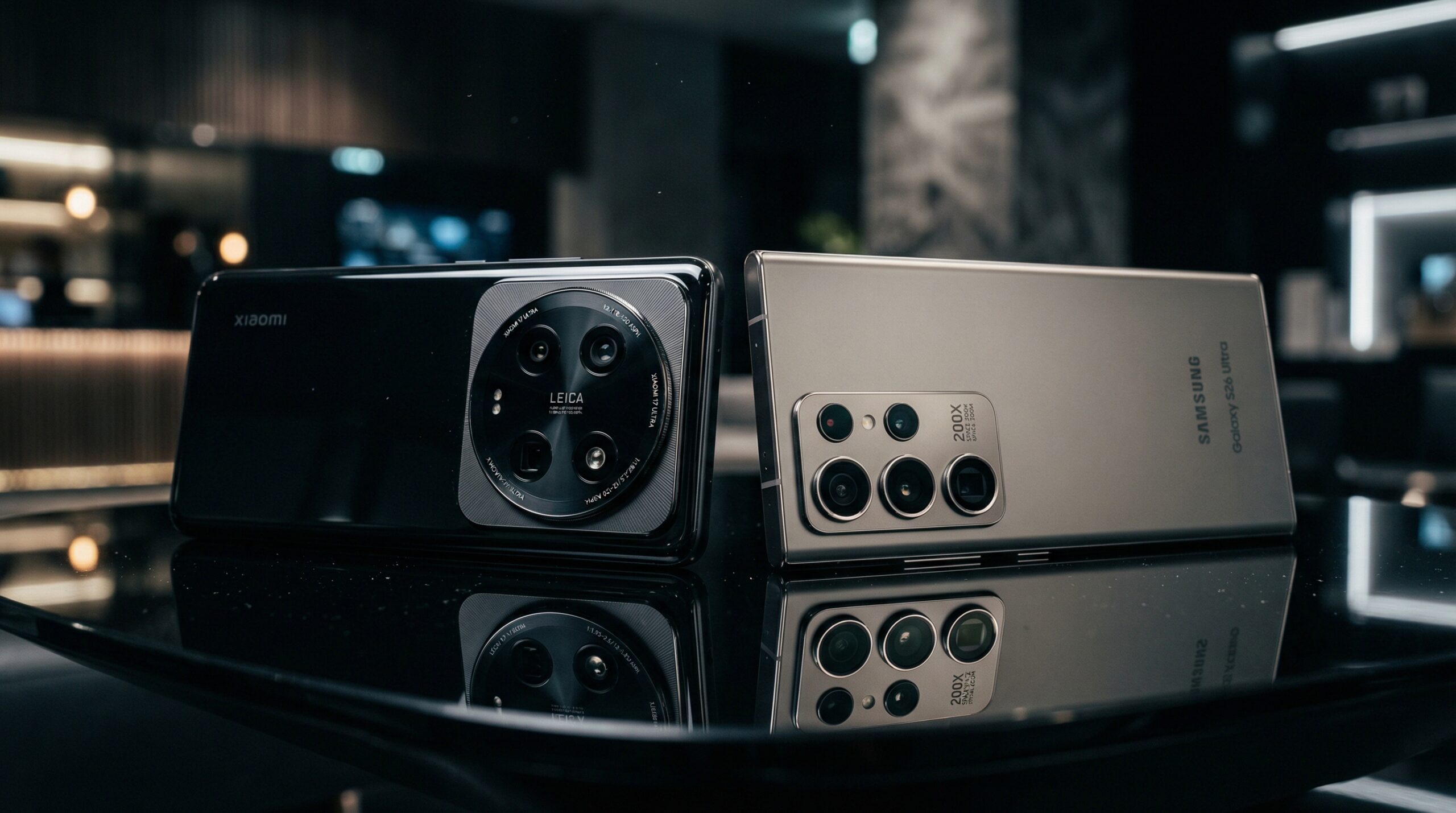
India’s premium smartphone market just got a genuinely difficult question. Both the Xiaomi 17 Ultra and Samsung Galaxy S26 Ultra launched at exactly ₹1,39,999. Not a rupee apart. This isn’t a coincidence — it’s a deliberate declaration by Xiaomi that it is no longer playing for second place in the premium camera segment.
Both run on the same Qualcomm Snapdragon 8 Elite Gen 5 (3nm). Both have 6.9-inch AMOLED displays. Both support Android 16. The performance war is essentially a draw. What separates them — decisively — is the camera system. And that’s the only fight that matters at ₹1.4 lakh.
We’ve gone through real-world testing data from Android Central, PhoneArena, Android Police, and Digital Camera World — all published in March 2026 — to give you the honest shootout that neither brand’s marketing will.
Camera Specs at a Glance
| Camera Specs | Xiaomi 17 Ultra vs Samsung Galaxy S26 Ultra |
| Main Camera | 50MP, 1-inch OmniVision OV50X (LOFIC), f/1.65, OIS — vs — 200MP main, f/1.7, OIS |
| Telephoto | 200MP, 1/1.4-inch, f/2.39–2.96, 3.2x–4.3x continuous optical zoom — vs — Dual tele: 50MP 3x + 50MP 5x |
| Ultra-Wide | 50MP, 14mm f/2.2, 115° FOV, autofocus — vs — 50MP ultra-wide |
| Selfie | 50MP, OIS (rare for front cam), 4K video — vs — 12MP |
| Zoom Range | 3.2x–4.3x optical | up to 17x optical-level | 120x digital — vs — 3x + 5x optical | up to 100x Space Zoom |
| Leica | Yes — Summilux optics, APO certified, Authentic + Vibrant modes — vs — No |
| DxOMark Score | 166 (one of 2026’s highest) — vs — 158 |
| HDR Tech | LOFIC HDR — precise highlights + shadow control — vs — Galaxy AI HDR processing |
| Video | 8K/30fps · 4K/120fps · 1080p slow-mo at 1920fps — vs — 8K/30fps · 4K/60fps |
| Price (India) | ₹1,39,999 — vs — ₹1,39,999 |
Round 1: Main Camera (Daylight)
The hardware gap here is not subtle. The Xiaomi 17 Ultra’s 1-inch OmniVision OV50X sensor is physically more than twice the area of Samsung’s main sensor. Larger sensors capture more light, produce shallower depth of field, and resolve finer detail — these are physics, not marketing.
In real-world daylight tests, the difference is visible but not overwhelming. Xiaomi’s Leica tuning produces natural, accurate colours — what photographers describe as ‘colour depth’. Skin tones are rendered with nuance. Foliage is green without the fluorescent push that Samsung’s processing sometimes adds. You can switch between Leica Authentic (true-to-life) and Leica Vibrant (punchy, saturated) modes — giving you two distinct creative personalities in one camera app.
Samsung’s Galaxy S26 Ultra responds with Galaxy AI’s adaptive scene processing — its algorithm analyses the scene, identifies subjects, and applies targeted sharpening and exposure adjustments per zone. In auto mode, Samsung photos require less editing before sharing. They look ‘finished’. Xiaomi’s Authentic mode can look comparatively flat to non-photographers who prefer punchier processing.
✅ Xiaomi 17 Ultra wins More natural colour, more light, more dynamic range — hardware advantage holds in daylight.
Round 2: Zoom Photography — The Decisive Battle
This is where the Xiaomi 17 Ultra makes its most compelling case — and where the gap is most dramatic. The 200MP telephoto with 1/1.4-inch sensor (almost as large as some main cameras) and continuous optical zoom from 3.2x to 4.3x via mechanical movement is a first in the smartphone industry.
The Leica APO (apochromatic) certification is not branding — it means special glass elements with extremely low light dispersion, eliminating the chromatic aberration (colour ‘ghosts’ around objects at zoom) that plagues even expensive DSLR lenses. In real testing, the 4.3x optical zoom on the Xiaomi delivers photos rivalling standalone cameras at this focal length. Android Central’s reviewer notes the zoom is used constantly: ‘it doubles as a portrait shooter, and Xiaomi made heady gains in this area.’
Samsung’s dual telephoto setup (3x + 5x) is the more versatile arrangement — two discrete optical zoom points vs Xiaomi’s continuous range. The Galaxy S26 Ultra’s Space Zoom reaches 100x digital. In raw telephoto head-to-head testing by PhoneArena and NoteBookCheck, however: Xiaomi’s 200MP telephoto at equivalent focal lengths consistently outresolves Samsung’s, with visibly more detail and fewer artefacts at 10x and beyond.
✅ Xiaomi 17 Ultra wins 200MP + Leica APO + larger sensor = the best zoom system on any smartphone in 2026.
Round 3: Low Light & Night Mode
Night photography is Samsung’s historical stronghold — ‘Nightography’ has been a Samsung Galaxy marketing pillar for three years. The S26 Ultra’s faster apertures and Galaxy AI’s multi-frame processing are genuinely competitive here.
The Xiaomi 17 Ultra’s LOFIC HDR technology (Large Over-Flow Integration Capacitor) gives the 1-inch sensor exceptional control over highlights in high-contrast scenes — exactly what night cityscapes present. Lamp posts don’t blow out. Dark alleys retain shadow detail. Across testing by multiple reviewers in conditions ranging from a Barcelona street at midnight to Delhi restaurant lighting, Xiaomi’s night shots are more technically accurate. However, as noted by BW Businessworld’s review: Xiaomi produces warmer tones at night — Leica’s colour signature. Those who prefer Samsung’s cooler, sharper, ‘cleaned-up’ night look may prefer the S26 Ultra’s output.
Samsung’s Galaxy AI at night remains impressive: multi-frame stacking, object-specific noise reduction, and real-time exposure assist make night shots more consistent across different users and lighting scenarios. The S26 Ultra is more forgiving of imperfect technique.
✅ Xiaomi 17 Ultra wins (technical accuracy) LOFIC HDR and Leica optics give a technical edge — but Samsung wins on consistency and processing style.
Round 4: Video
Both shoot 8K at 30fps and 4K at 60fps. The differences emerge at higher framerates and in stabilisation quality. The Xiaomi 17 Ultra’s 4K at 120fps and ultra slow-motion at 1,920fps outspec Samsung’s 4K at 60fps ceiling. The 50MP front camera with OIS (rare for a selfie camera) is a vlogger’s dream.
Samsung counters with more refined Log video support, Director’s View (simultaneous front and rear capture), and Galaxy AI’s video enhancement features including object eraser and motion analysis in post. For professional video work and content creation with detailed post-production, Samsung’s ecosystem is more complete.
Stabilisation: Both use OIS + EIS combination. Real-world footage from both phones while walking is smooth enough to not require a gimbal for casual content. Xiaomi’s AI stabilisation layer is slightly more aggressive in handheld walk-and-shoot scenarios, occasionally introducing a ‘processed’ look at maximum stabilisation setting.
Marginal win — Samsung Galaxy S26 Ultra Better video ecosystem, Log support, and Director’s View give Samsung the creative video edge.
Round 5: Selfie Camera
The 17 Ultra’s 50MP front camera with OIS is the highest-spec selfie camera on this list and one of the best on any smartphone in 2026. Indian skin tones render with accuracy — texture is preserved rather than smoothed into plastic-finish AI beauty. 4K video from the front camera is genuinely impressive for vlogging.
Samsung’s 12MP selfie camera is the only obvious hardware downgrade on the S26 Ultra versus the 17 Ultra. Samsung’s AI processing compensates meaningfully — Galaxy AI enhances selfie portraits with precise edge detection — but in detail and texture, the 50MP Xiaomi sensor simply resolves more information.
✅ Xiaomi 17 Ultra wins 50MP with OIS vs 12MP — it’s not close. Best selfie camera at this price point.
Round 6: AI Features & Software
This is Samsung’s ground. Galaxy AI is the most comprehensive mobile photography AI system available in 2026 — Photo Assist (object removal, sky replacement, generative fill), Nightography enhancements, Real Zoom AI, Live Translate in the camera viewfinder, and Circle to Search integration. These features work consistently and are genuinely useful in daily shooting.
Xiaomi’s Leica native dual image quality mode, intelligent scene recommendation, automatic super moon detection, and content authentication (CAI standard) are thoughtful additions — but the breadth of Galaxy AI’s non-photography features (translation, summary, editing tools) gives Samsung’s ecosystem an edge for power users who live in their phone’s AI layer.
Software updates: Samsung promises 7 years of OS updates vs Xiaomi’s 4 years. For a ₹1.4 lakh phone, this is a meaningful long-term consideration.
✅ Samsung Galaxy S26 Ultra wins Galaxy AI’s depth, 7-year update promise, and S Pen ecosystem are Samsung’s strongest cards.
The Scorecard
| Round | Winner | Margin |
| Main Camera — Daylight | Xiaomi 17 Ultra | Clear — 1-inch sensor + Leica natural colour |
| Zoom Photography | Xiaomi 17 Ultra | Decisive — 200MP APO zoom vs dual fixed teles |
| Low Light / Night | Xiaomi 17 Ultra | Narrow — technical accuracy, warmer tones |
| Video | Samsung Galaxy S26 Ultra | Marginal — better ecosystem + Log support |
| Selfie Camera | Xiaomi 17 Ultra | Clear — 50MP OIS vs 12MP |
| AI Features & Software | Samsung Galaxy S26 Ultra | Clear — Galaxy AI depth + 7-year updates |
| DxOMark | Xiaomi 17 Ultra | 166 vs 158 |
| Battery (bonus) | Xiaomi 17 Ultra | 6,000mAh + 90W vs 5,000mAh + 60W |
| Overall Camera Winner | Xiaomi 17 Ultra 5–2 | Cameras, sensors, and Leica optics win |
Who Should Buy Which?
Buy the Xiaomi 17 Ultra if you…
- Shoot a lot of photos and want the technically superior camera system
- Love photography and appreciate Leica’s colour science and natural rendering
- Use telephoto zoom frequently — wildlife, sports, travel, architecture
- Want the best selfie camera at this price (50MP + OIS)
- Value battery capacity — 6,000mAh + 90W charging vs 5,000mAh + 60W
- Want the highest DxOMark-ranked camera phone at ₹1,39,999
Buy the Samsung Galaxy S26 Ultra if you…
- Live inside Samsung’s ecosystem (Galaxy Watch, Galaxy Buds, SmartThings)
- Use the S Pen daily — note-taking, PDF annotation, precision drawing
- Want 7 years of guaranteed Android OS updates vs Xiaomi’s 4
- Prefer Samsung’s AI-processing aesthetic — sharper, cooler, more ‘finished’
- Do professional video work and value Galaxy AI video features + Log support
- Prefer the Samsung after-sales service network in India
INDIA AVAILABILITY NOTE
The Xiaomi 17 Ultra ships India without the Leica Edition (which includes the mechanical zoom ring). You get the full 200MP APO Leica camera system — just without the physical rotating zoom ring. The global variant launched on Amazon India and Mi.com from March 2026.
Verdict: The Cameras Have a New King
At the same price, the Xiaomi 17 Ultra wins the camera war. Not by a narrow margin in one category — but across five of the six rounds, including the decisive ones: main camera, zoom, and selfie. The 1-inch LOFIC sensor, the 200MP Leica APO telephoto, and a DxOMark score of 166 represent the current ceiling of Android camera engineering in 2026.
But this is a phone, not a camera. The Galaxy S26 Ultra’s Galaxy AI depth, S Pen ecosystem, 7-year software support, and Samsung’s India service network are real, meaningful advantages for users who are buying a smartphone — not a Leica replacement. If you live in Samsung’s world, the camera gap alone isn’t enough to pull you out.
For pure photography at ₹1,39,999: Xiaomi 17 Ultra. It’s the finest Android camera phone of 2026 — and BW Businessworld’s India review calls it exactly that: ‘the most convincing argument for the Xiaomi-Leica partnership since it began.’
TrendingIndiaToday Camera Verdict: 🏆 Best Camera: Xiaomi 17 Ultra — DxOMark 166, Leica APO, 1-inch sensor, 200MP zoom 📊 Best All-Rounder: Samsung Galaxy S26 Ultra — AI, S Pen, 7-year updates, ecosystem
Both phones are at ₹1,39,999 (ex-showroom) in India as of March 2026. Available on Amazon India and brand official stores. Camera comparisons are based on independent reviews from Android Central, PhoneArena, Android Police, BW Businessworld, and Digital Camera World.
About the Author