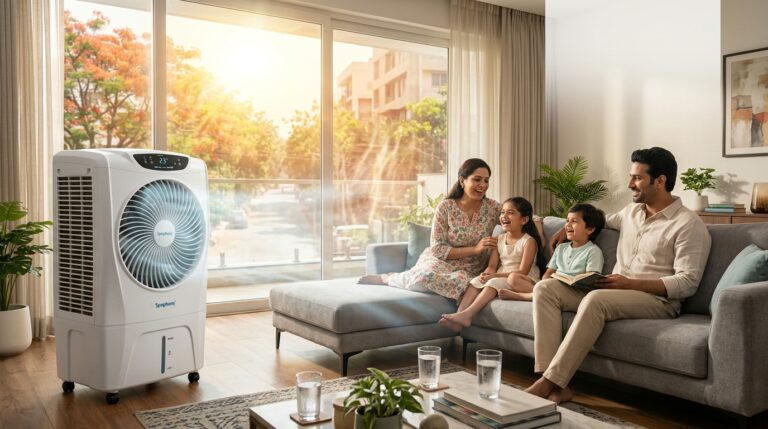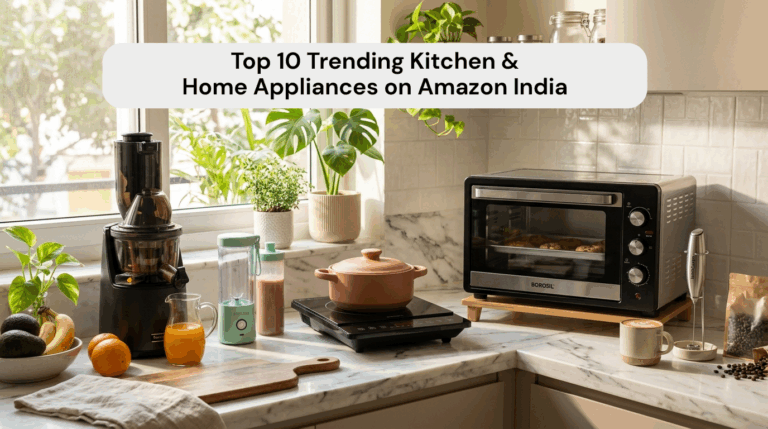

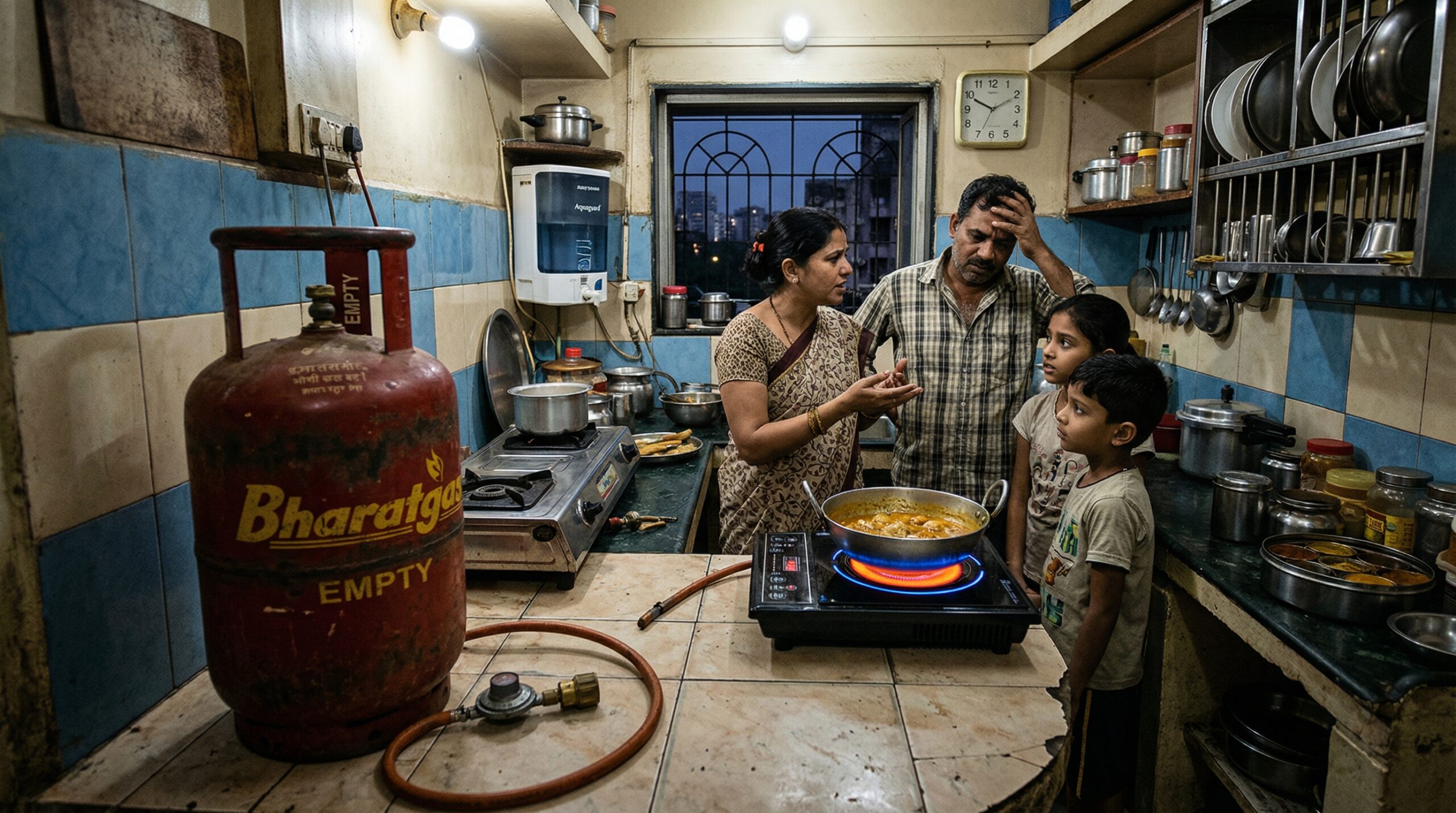
When US and Israeli strikes on Iran effectively shut down the Strait of Hormuz in late February 2026, India’s kitchen fuel supply unravelled within days. Over 90% of India’s LPG imports pass through that narrow waterway — and now, 332 million households that depend on cooking gas are scrambling for alternatives. Queues at cylinder distributors, black-market prices doubling overnight, and hotel closures from Kerala to Delhi have made one thing undeniably clear: India’s LPG dependence is a vulnerability we can no longer ignore. The good news? Reliable, affordable electric alternatives exist — and many are available right now on Amazon and Flipkart.
90% of India’s LPG imports routed through the Strait of Hormuz
332M active LPG connections now affected by the supply crunch
60% of India’s LPG demand is import-dependent — nearly double domestic production
Why this crisis is different — and more serious
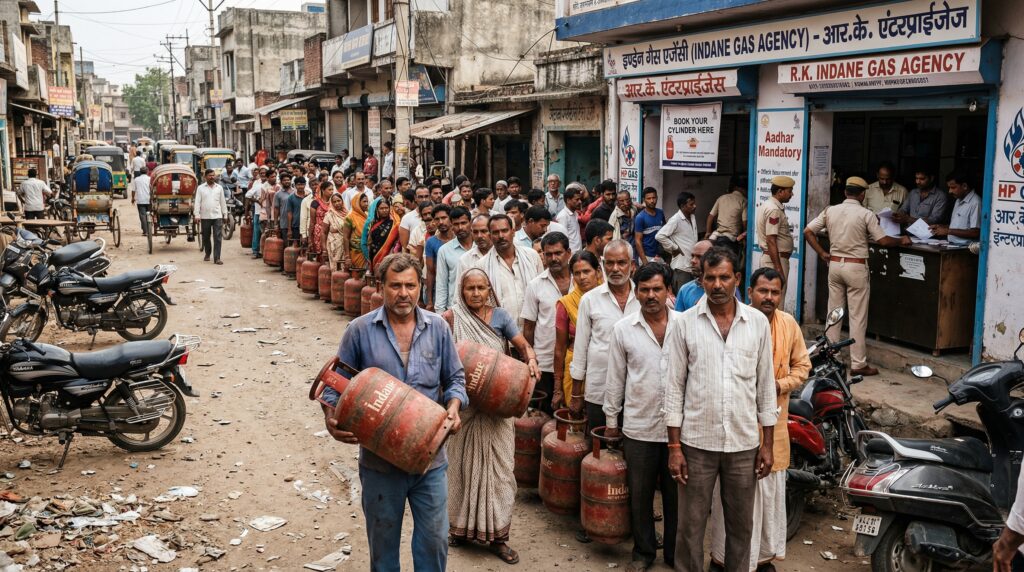
India is the world’s second-largest LPG importer, consuming over 31 million metric tonnes annually. Domestic production covers barely half that. When the Strait of Hormuz closed, weekly LPG inflows dropped an estimated 30% overnight, while tanker war-risk premiums surged over 500%. The government responded quickly — invoking the Essential Commodities Act, directing refineries to maximise LPG yields, and distributing emergency kerosene — but the structural gap remains wide.
States like Kerala, Maharashtra, and Andhra Pradesh saw supply drops of 40–50% for commercial users. Hotels closed, wedding halls shut down, and eateries returned to firewood. For households, the government prioritised domestic LPG — but “prioritised” does not mean “unaffected.” Booking delays, dry-outs, and anxiety are widespread.
💡 The Andhra Pradesh government announced a ₹2-per-unit electricity subsidy for eateries switching to induction cooking — a clear signal that electric alternatives are now official policy, not just a consumer choice.
The 5 best electric alternatives for your kitchen — right now
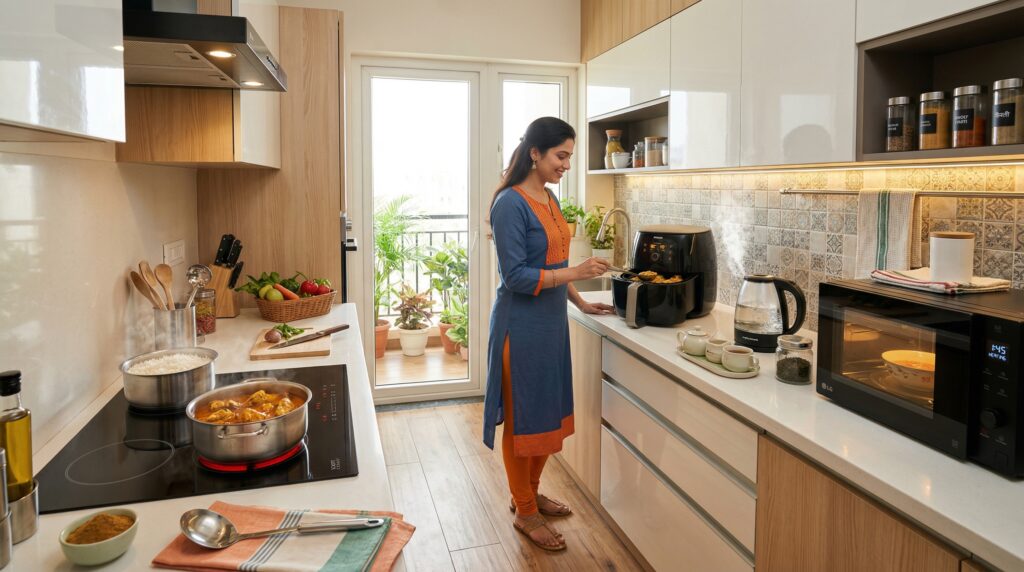
These are not long-term hypotheticals like biogas plants or solar steam kitchens (though we cover those too). These are appliances available today, affordable, and capable of handling the full range of Indian cooking.
🔥Induction Cooktop — #1 Priority Buy
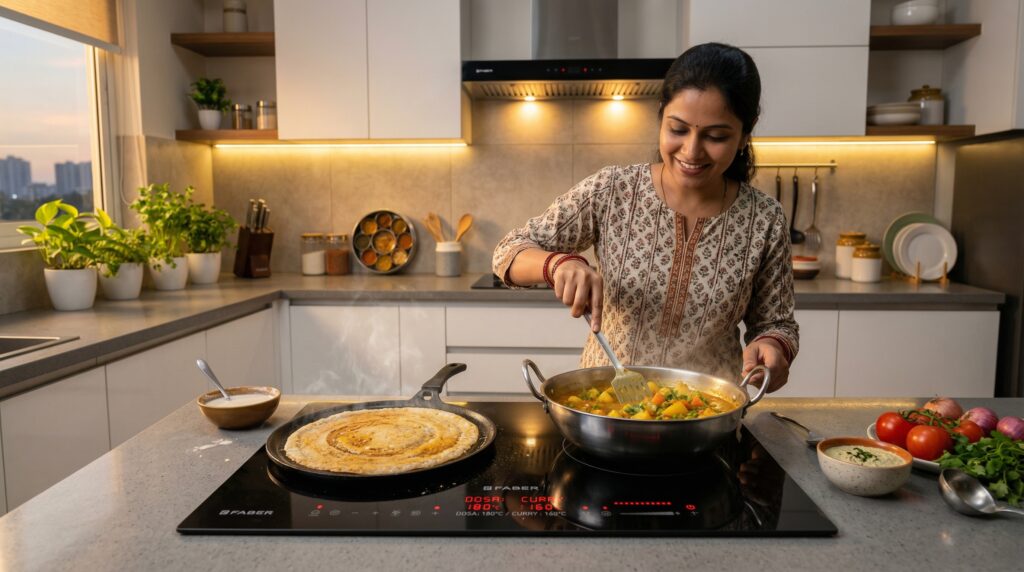
Best all-round gas stove replacement for Indian kitchens
Induction cooktops use electromagnetic technology to heat cookware directly, making them 50% faster than gas and up to 90% energy-efficient. Since the crisis hit, sales have surged so dramatically that several models are out of stock across Flipkart and Amazon. If you see stock — buy immediately.
Modern induction cooktops come with Indian-specific presets: dosa, idli, dal, roti, curry, and even a whistle counter for pressure cookers. Brands like Prestige (PIC 6.1 V3) automatically detect pressure cooker whistles and adjust heat accordingly — a genuinely useful feature for Indian kitchens.
Running an induction cooktop costs just ₹2–4 per hour of electricity versus ₹8–12 per hour equivalent for LPG. A typical family saves ₹2,000–4,000 annually, and the cooktop pays for itself in 3–6 months.
What to look for: 2000W minimum power, ISI mark (BIS certified), 4kV surge protection, auto shut-off, and Indian preset menus. Avoid the cheapest no-brand models — for daily Indian cooking, reliability matters.
Important: Standard induction cooktops only work with flat-bottomed magnetic cookware (stainless steel, cast iron). If you use aluminium vessels or curved-bottom cookware, choose an infrared cooktop like the Bajaj IRX 220F instead — it works with all utensil types.
| Model | Power | Price | Best For |
|---|---|---|---|
| Philips HD4938 ★ Top Pick | 2100W | ₹3,500 | Families, daily heavy use |
| Prestige PIC 6.1 V3 | 2200W | ₹3,200 | Pressure cooker users |
| Pigeon Acer Plus Budget | 1800W | ₹1,300 | Students, PG, backup |
| Bajaj IRX 220F (Infrared) | 2200W | ₹2,800 | Aluminium vessel users |
| Havells Evo Cook TC20 | 2000W | ₹2,500 | Safety-focused buyers |
🍲Electric Pressure Cooker / Instant Pot
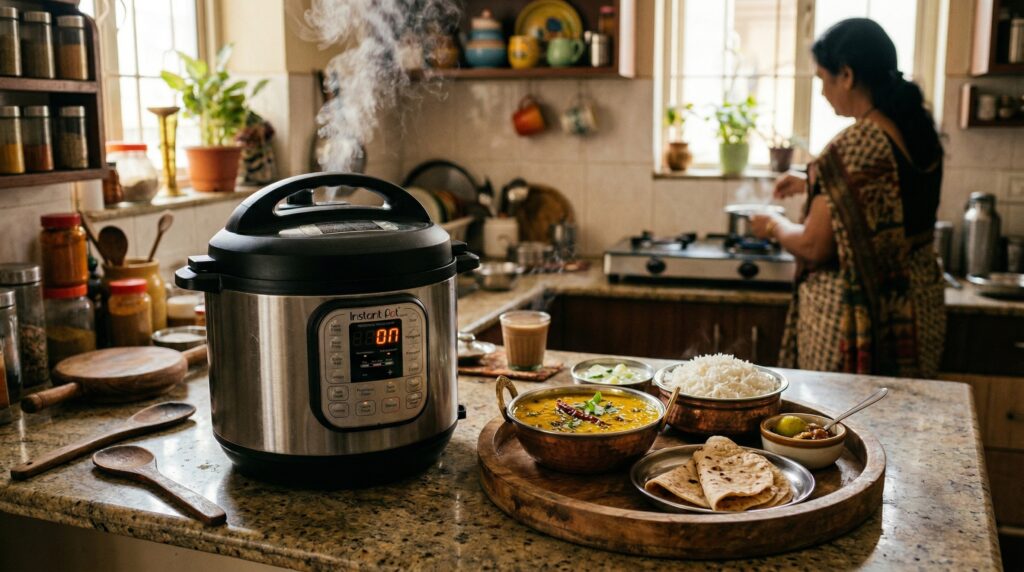
Dal, rice, khichdi, biriyani — all without a single cylinder
For the majority of Indian households, the pressure cooker is the single most-used cooking vessel. An electric pressure cooker (also sold as Instant Pot or multi-cooker) replaces it entirely — with no open flame, no gas, and no whistle-counting. It can cook dal in 15 minutes, rice in 10, and biriyani with a single button.
Brands like Instant Pot, Prestige, and Pigeon offer models with Indian preset modes. Some include slow-cook, sauté, steam, and yogurt-making functions — making this one appliance a serious multi-tasker.
| Model | Capacity | Price | Best For |
|---|---|---|---|
| Instant Pot Duo 7-in-1 ★ Top Pick | 5.7 L | ₹7,999 | Families of 4–6 |
| Prestige Electric Cooker | 5 L | ₹3,500 | Everyday dal-rice-sabzi |
| Pigeon Healthifry | 4 L | ₹2,200 | Small families |
📦Convection Microwave Oven
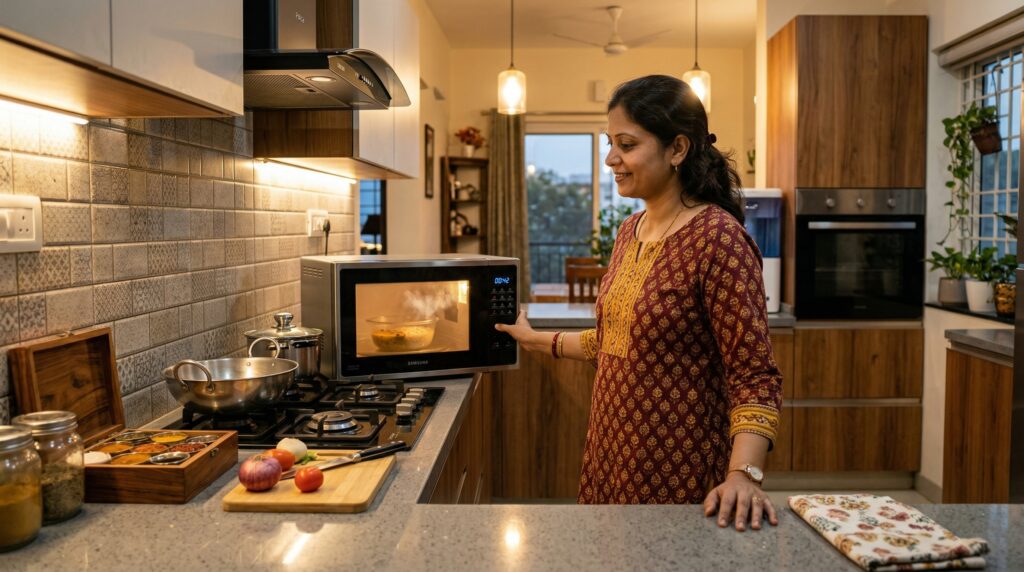
Reheat, bake, grill — and reduce gas use by 40%
If you already own a microwave, you are partially ahead of the crisis. Microwave ovens can reheat leftovers, prepare dal-rice, steam vegetables, and handle a surprising range of Indian dishes. A convection microwave can even bake rotis and grill chicken — all without gas.
The key insight: you do not need to cook everything from scratch in a microwave. Use it to reheat bulk-cooked meals, which drastically reduces your daily LPG consumption. Cook a large pot of dal every two days and microwave individual portions — this strategy alone can cut your cylinder usage by 35–40%.
| Model | Capacity | Price | Best For |
|---|---|---|---|
| Samsung 28L Convection ★ Top Pick | 28 L | ₹12,999 | Full family use |
| IFB 25L Convection | 25 L | ₹10,500 | Mid-sized households |
| LG 20L Solo Microwave Budget | 20 L | ₹5,999 | Reheat and basic cooking |
💨Air Fryer
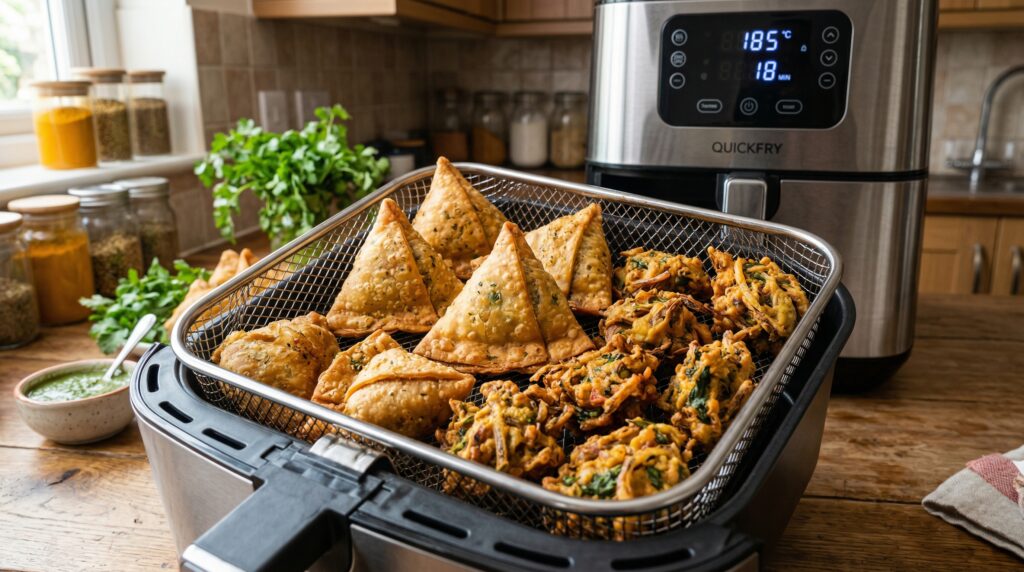
Snacks, pakodas, roasted vegetables — no gas, minimal oil
Air fryers have exploded in popularity in Indian homes over the past two years, and the LPG crisis gives them a second purpose beyond healthy cooking: gas conservation. Use your air fryer for samosas, pakodas, tandoori-style dishes, and roasted vegetables — tasks that would ordinarily keep a burner running for 20–30 minutes.
Modern large-capacity air fryers (5–7 litres) can handle a family’s snack and side-dish needs efficiently. They do not replace your main burner for curries and dal — pair with an induction cooktop for full coverage.
| Model | Capacity | Price | Best For |
|---|---|---|---|
| Philips NA120 ★ Top Pick | 4.1 L | ₹8,995 | Daily snacks for family |
| Havells Prolife Digi | 5 L | ₹5,999 | Large batches |
| Agaro Regency Budget | 5 L | ₹3,499 | Budget households |
☕Electric Kettle + Instant Water Heater
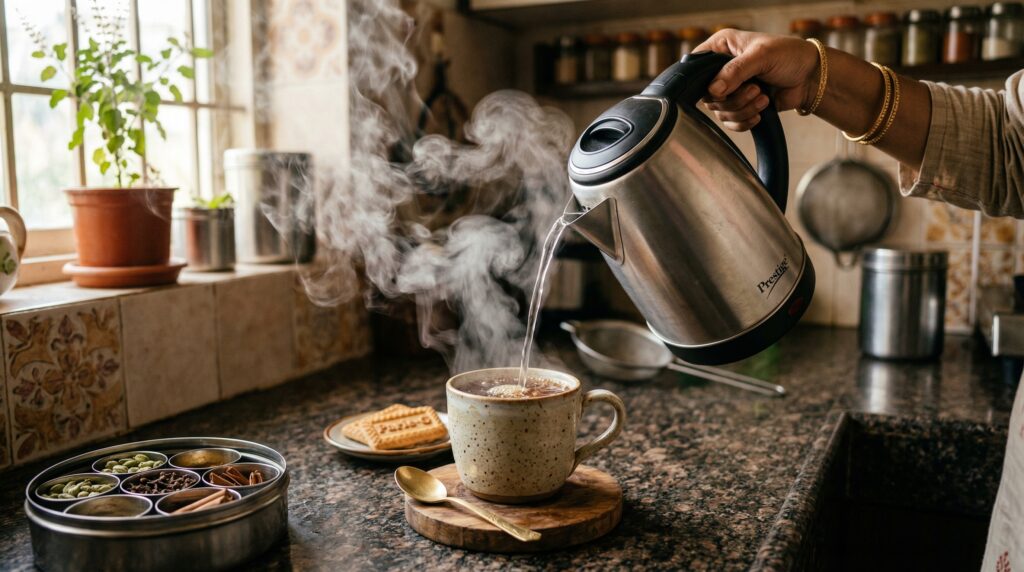
Small but saves surprisingly large amounts of gas
It sounds minor, but many Indian households burn significant LPG simply boiling water — for chai, coffee, oats, instant noodles, soups, or hot water for dough. An electric kettle eliminates all of this in 3 minutes for roughly ₹0.50 per boil. If your family makes 4–5 cups of chai a day, this alone saves meaningful cylinder time.
Stainless steel body kettles (1.5–1.8 litres) from brands like Bajaj, Prestige, and iBell are available from ₹600 to ₹2,000 and are an easy first step for households not ready to invest in induction cooktops yet.
The longer view: sustainable alternatives beyond the crisis
While induction cooktops solve the immediate problem, the LPG crisis has exposed a deeper structural vulnerability: India imports 60% of its LPG demand, and 90% of those imports come through a single chokepoint. Analysts and policy researchers are now calling this a defining moment to diversify India’s cooking-energy mix.
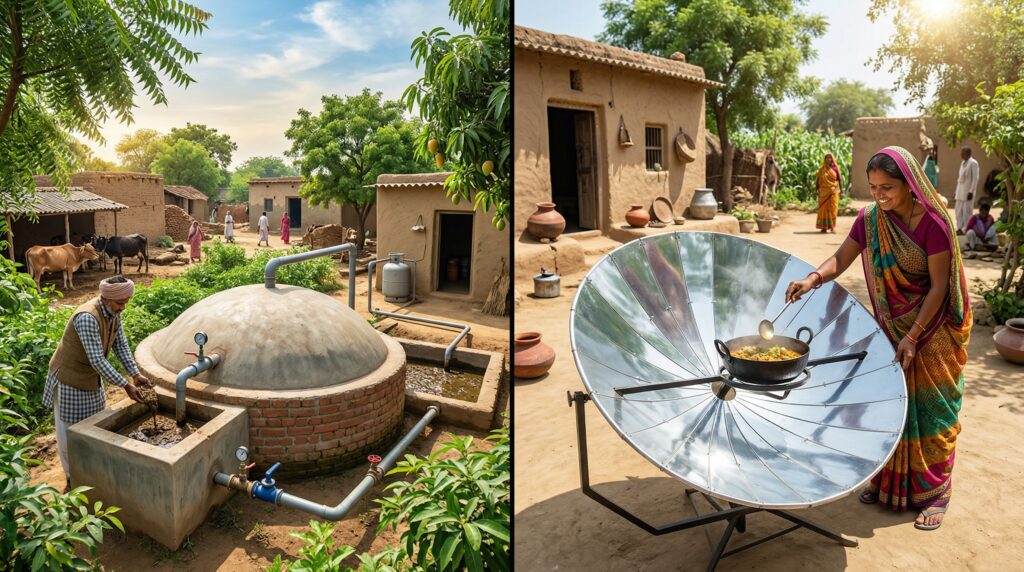
Biogas — making a comeback
Biogas produced from kitchen waste, cow dung, and agricultural residue is gaining renewed attention in Kerala, Maharashtra, and Gujarat. Household biogas plants (around ₹55,000 each) can process 10–12 kg of kitchen waste and water daily to produce roughly half a kilogram of LPG-equivalent gas. For institutions and community setups, this is increasingly viable.
Solar cookers — underutilised despite great potential
India has exceptional solar potential across most of the country, yet solar cooking has never scaled. The barrier is cultural — cooking is an indoor activity for most families — but large institutions like the Shirdi Sai Baba shrine already use solar steam piped into kitchens. The crisis may finally accelerate the development of compact, modern solar cooker designs for home use.
🌱 The IISD’s February 2026 report, “India’s Clean Cooking Shift,” found that electric cooking is now the most practical near-term path to reducing India’s structural LPG dependence — faster to adopt, cheaper to run, and already widely available.
Practical tips for the current shortage
- Buy induction first, worry about utensils second. Most Indian stainless steel and cast iron cookware already works on induction. Flat-bottomed vessels are the only requirement — a cheap kadai or pressure cooker from a local shop will do.
- Cook in batches. Prepare large quantities of dal, rice, and sabzi every two days and reheat portions in a microwave. This single change can halve your LPG usage without buying any new appliance.
- Reserve LPG for high-heat tasks only. Tadka (tempering) and roti-making are hard to replicate electrically. Use your cylinder for these and handle everything else electrically.
- Check voltage in your home. Induction cooktops draw 2000W+ — ensure your wiring and fuse box can handle the load, especially in older apartments. Most models include voltage protection, but physically check your circuit breaker rating.
- Register your LPG connection online. Use the official HP Gas, Bharat Gas, or IndanGas apps to stay updated on refill timelines and avoid panic-buying or black-market cylinders.
- Avoid firewood inside homes. While some households have fallen back on wood and biomass, indoor burning causes severe air quality problems. This is a health risk, not just an inconvenience — especially for children and the elderly.
Bottom line: This crisis is also an opportunity
India’s LPG shortage of 2026 is painful, inconvenient, and revealing. It has shown how a single geopolitical flashpoint thousands of kilometres away can disrupt the daily meals of 330 million households. But it is also a practical opportunity — to invest in electric cooking infrastructure, reduce structural dependence on a volatile import chain, and discover that induction cooktops are, in many ways, simply better than gas.
The Philips HD4938 or Prestige PIC 6.1 V3 will outlast this crisis by years. The habits of batch cooking, smart reheating, and appliance diversification will serve your family long after the Strait of Hormuz reopens. Treat this disruption as the nudge India needed to modernise its kitchens.
Prices cited are approximate as of March 2026 and may vary by retailer. Always verify stock availability on Amazon.in or Flipkart before purchase. For government updates on LPG supply, check mopng.gov.in.
About the Author